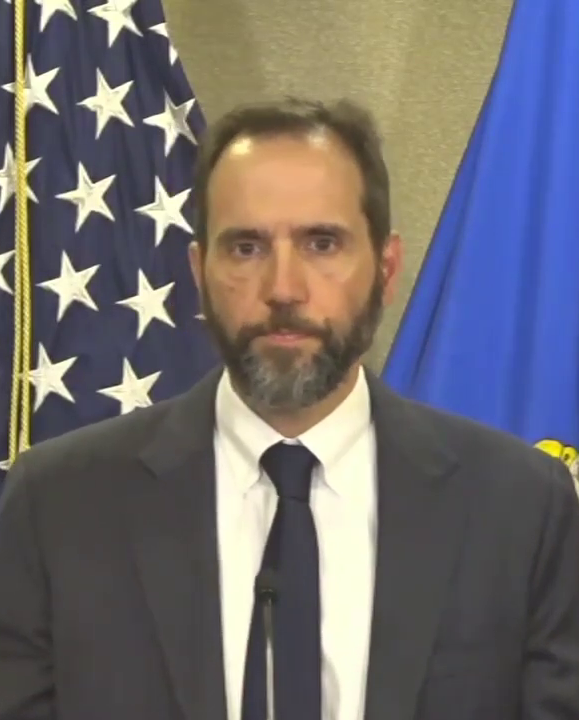
Above: Jack Smith, former U.S. Department of Justice special counsel, delivering a statement on the indictment of Donald J. Trump, June 2023. (Photo: U.S. Department of Justice, public domain.)
This deep dive is about Jack Smith, the special counsel who built two federal criminal cases against Donald Trump — one for trying to overturn the 2020 election, one for hoarding classified documents at Mar-a-Lago — and who told the U.S. Senate on September 29, 2026 that his evidence proved “serious crimes” beyond a reasonable doubt. Neither case ever reached a jury. Here is everything he had, why it stalled, and the only roads left.
Our view, stated plainly: we think Donald Trump is the most corrupt president in American history. What follows is not opinion — it is the record, sourced. Trump pleaded not guilty in both federal cases and has denied all wrongdoing.
Who Jack Smith is
- Career prosecutor, not a politician. Former chief of the Justice Department’s Public Integrity Section and chief prosecutor at the Kosovo Specialist Chambers in The Hague, where he prosecuted war crimes.
- Appointed November 18, 2022 by Attorney General Merrick Garland to take over both Trump investigations.
- Resigned in January 2025, days before Trump’s second inauguration, after filing his final report.
Case one: the 2020 election (Washington, D.C.)
Indicted August 1, 2023 — four felony counts: conspiracy to defraud the United States (18 U.S.C. § 371), conspiracy to obstruct an official proceeding and obstruction of that proceeding (18 U.S.C. § 1512), and conspiracy against rights (18 U.S.C. § 241).
The evidence, as laid out in the indictment and Smith’s final report:
- He knew he lost. The report calls deceit — knowingly false claims of election fraud — the thread running through everything. Aides, officials and his own campaign told him the fraud claims were false; he kept making them.
- The states. Pressure on officials in states he lost to block certification — including the January 2, 2021 call asking Georgia’s secretary of state to “find 11,780 votes.”
- The fake electors. Slates of fraudulent electors organized in seven states Joe Biden won, to be presented to Congress as real.
- The Justice Department. Pressure on DOJ leadership to open what the report calls “sham election crime investigations,” and a push to install Jeffrey Clark as acting attorney general to lend them weight.
- Mike Pence. Day-after-day pressure on the vice president to reject the electoral count — documented in Pence’s own contemporaneous handwritten notes.
- January 6 itself. At 2:24 p.m., with the Capitol already breached, Trump posted that “Mike Pence didn’t have the courage to do what should have been done.”
- The scale. About 250 witnesses interviewed voluntarily and 55 called before the grand jury.
Smith’s bottom line, in Volume One of his final report (released January 14, 2025): “but for Mr. Trump’s election and imminent return to the Presidency, the Office assessed that the admissible evidence was sufficient to obtain and sustain a conviction at trial.”
What stopped it: the Supreme Court’s Trump v. United States ruling (July 1, 2024) granted presidents broad immunity for official acts, gutting the DOJ-pressure evidence. Smith re-indicted on a narrower theory in August 2024. After Trump won the election, the case was dismissed at the Justice Department’s request in November 2024, under the department’s long-standing policy that a sitting president cannot be prosecuted.
Case two: the classified documents (Florida)
Indicted June 2023; superseded in July 2023 to 40 counts, most of them willful retention of national defense information under the Espionage Act, plus obstruction and false statements. Aide Walt Nauta and Mar-a-Lago property manager Carlos De Oliveira were charged alongside him.
The evidence, from the indictment:
- Boxes everywhere. Classified records stored in a ballroom, a bathroom and shower, an office, his bedroom and a storage room at Mar-a-Lago — a club with thousands of guests.
- The Bedminster tape. A July 2021 recording of Trump showing a military document to people without clearances: “As president I could have declassified it. Now I can’t.”
- Hiding them from his own lawyer. Nauta moved dozens of boxes before a Trump attorney searched for subpoenaed records; Trump suggested the lawyer “pluck” out anything bad.
- The false certification. In June 2022 his team handed over 38 documents and certified a diligent search had been done. Two months later, on August 8, 2022, the FBI found more than 100 classified documents.
- The camera server. After a grand jury subpoenaed Mar-a-Lago security footage, De Oliveira allegedly told a staffer that “the boss” wanted the server deleted.
What stopped it: Judge Aileen Cannon, a Trump appointee, dismissed the case in July 2024, ruling Smith’s appointment unlawful. The Justice Department dropped its appeal as to Trump after the election. On February 23, 2026, Cannon permanently blocked the release of Smith’s Volume Two, the documents report — so the public has still never seen it.
Smith under oath, September 29, 2026
- “Beyond a reasonable doubt.” Testifying to the Senate Judiciary Committee, Smith said his investigation developed proof beyond a reasonable doubt that Trump engaged in serious crimes (NPR, ABC News).
- “I stand by” it. Faced with the same facts today, he said, he would make the same decision to charge — regardless of party.
- Republicans’ answer was to accuse him of abusing his authority, with some calling for him to be prosecuted instead.
The scoreboard, as of today
- Federal election case: dismissed, November 2024.
- Federal documents case: dismissed; Volume Two sealed.
- Georgia election case: dropped and dismissed November 26, 2025 after Fani Willis was removed and a new prosecutor took over.
- New York: the one that stuck. Trump stands convicted of 34 felony counts of falsifying business records. His state appeal is pending, and in August 2026 a federal judge again refused to move the case to federal court.
Next steps: what it would actually take
The clock is the enemy. Most federal crimes carry a five-year statute of limitations, and Justice Department policy bars charging a sitting president. Trump’s term runs to January 20, 2029.
- January 6 charges: the window has closed. Five years from the conduct ran out in January 2026.
- Documents charges: the window closes in 2027. The retention ended with the August 2022 search and the obstruction happened in mid-2022, so the five-year clock runs out in mid-to-late 2027 — before he leaves office. This is also the strongest case legally: keeping documents after leaving office is private conduct, outside the Supreme Court’s immunity ruling.
- Road one: Congress pauses the clock. Congress can extend a limitations period that has not yet expired; what the Constitution forbids is reviving one that already has (Stogner v. California, 2003). A law tolling the clock while a president is in office would have to pass both chambers and survive a veto — before mid-2027. That runs straight through the November 3, 2026 midterms.
- Road two: free Volume Two. Transparency groups American Oversight and the Knight First Amendment Institute are appealing Cannon’s order to the Eleventh Circuit. If it is released, the public sees the documents evidence in full.
- Road three: New York. The 34-count conviction stands unless the appeals courts throw it out. Defending it is the Manhattan district attorney’s job, and it is the only criminal verdict on the books.
- Road four: impeachment. The House can impeach and the Senate can convict and disqualify — but the penalty is removal from office, not prison, and it takes two-thirds of the Senate.
- The wild card: pardons. Whether a president can pardon himself has never been tested in court.
Bottom line: Jack Smith did his job. The evidence exists, grand juries in two cities voted to indict on it, and he stood by it under oath this fall. Whether anyone ever answers for it now depends less on prosecutors than on Congress, the courts — and the voters in two weeks.
Sources: ABC News on Volume One · NPR and CNN on the Senate testimony · CBS News and CNN on Volume Two · the documents case · NPR on Georgia · CNBC on New York. Photo: U.S. Department of Justice via Wikimedia Commons, public domain.

Leave a Reply